

Continuous glucose monitoring (CGM) technology uses a small wearable or implanted sensor to measure glucose in the interstitial fluid every few minutes and transmit the readings to a phone, a receiver, or an insulin delivery system. Almost every CGM sold in the United States today relies on one of two sensing methods: an enzymatic electrochemical sensor worn on the skin for about one to two weeks, or a fluorescence-based optical sensor implanted under the skin for up to a year. No noninvasive glucose monitor has been authorized by the FDA.
This guide is written for device makers and product teams. It explains how current CGM sensors work, which systems are on the US market, how the main sensing approaches compare, and which newer technologies are closest to commercial use. Device facts were checked against FDA and manufacturer sources on October 11, 2026.
For market size, app features, and regulatory strategy, see the CGM software guide.
How CGM Technology Works Today
CGM technology measures glucose in interstitial fluid, the fluid that surrounds cells under the skin, rather than in the blood. A sensor converts the glucose concentration into an electrical or optical signal, a transmitter sends that signal over a wireless link, and software turns it into a glucose value and a trend. Two sensing methods account for CGM systems on the US market.
Enzymatic electrochemical sensors
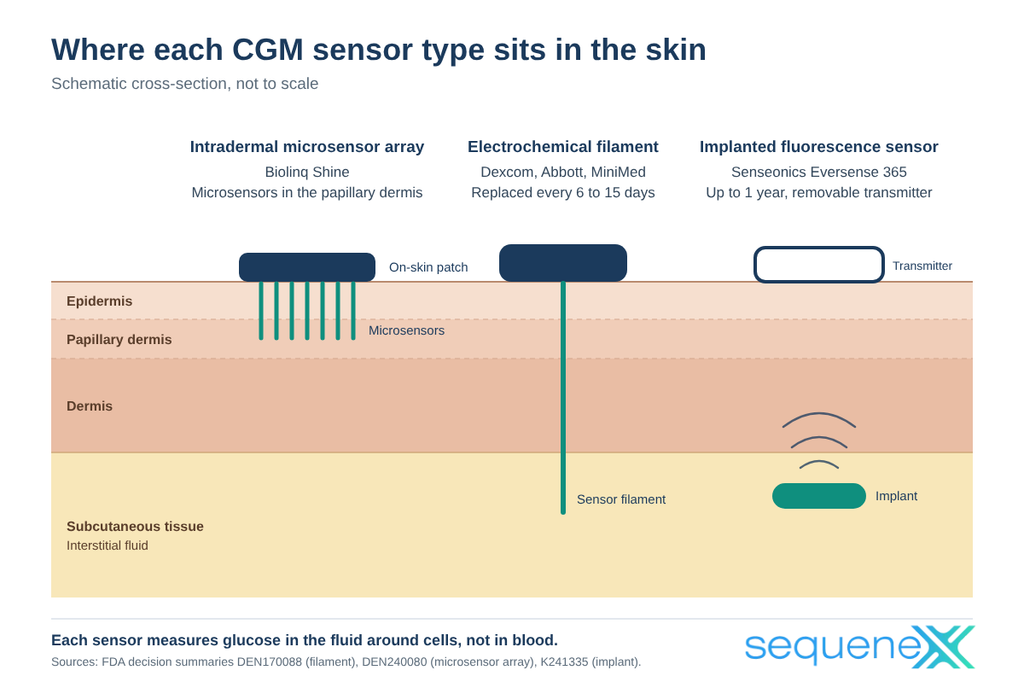
An enzymatic electrochemical CGM sensor is a thin filament inserted just under the skin and coated with the enzyme glucose oxidase. The enzyme reacts with glucose, producing a small electrical current that rises and falls with glucose concentration.
- Dexcom’s FDA decision summary describes its sensor as measuring interstitial glucose “via an enzymatic electrochemical reaction using glucose oxidase” (FDA, DEN170088).
- Abbott’s FreeStyle Libre sensors use amperometric measurement of a current proportional to glucose in interstitial fluid (FDA, K233537).
- MiniMed’s Simplera sensor also uses glucose oxidase (Simplera user guide).
These sensors are disposable. Each one needs a warm-up period after insertion before it reports values: 30 minutes for the Dexcom G7 (FDA, K213919), 60 minutes for the G7 15 Day (Dexcom), and two hours for Simplera. Routine fingerstick calibration is no longer the norm. Simplera and Guardian 4 do not require calibration, and the FreeStyle Libre 3 is factory calibrated and “cannot be calibrated by the user” (FDA, K212132).
Implantable optical sensors
An implantable optical CGM sensor measures glucose using fluorescence rather than an enzymatic reaction. The Senseonics Eversense sensor is placed fully under the skin by a clinician. Glucose binds to an indicator molecule in the sensor, increasing its fluorescence intensity, and a transmitter worn over the site reads that signal (FDA, K241335). The transmitter can be taken off and put back on without replacing the sensor.
The trade-off is a minor procedure in exchange for a much longer sensor life. Eversense 365 lasts up to one year and needs fingerstick calibration primarily once per week after day 14 (Senseonics).
Why CGM readings lag behind blood glucose
CGM readings lag behind blood glucose because glucose takes time to move from the bloodstream into interstitial fluid. A tracer study in healthy, fasted adults measured a mean lag of 5.3 to 6.2 minutes (Basu et al., Diabetes, 2013). Sensor response time and signal filtering add to that delay, which is why trend arrows and predictive alerts matter as much as the current value.
How CGM accuracy is reported
CGM accuracy is usually reported as mean absolute relative difference (MARD), the average of the absolute differences between CGM values and reference values, expressed as a percentage. A lower MARD means closer agreement with the reference.
MARD is useful but limited. A review in the Journal of Diabetes Science and Technology concluded that MARD “should not be used as the sole parameter to characterize CGM systems” because it does not show the direction of error and can hide short periods of large error (Heinemann et al., 2020).
Manufacturers report overall MARD values of 8.2% for the Dexcom G7, 8.0% for the G7 15 Day, and 7.9% for the FreeStyle Libre 3. These are company figures from separate studies. FDA decision summaries report accuracy by glucose range and wear period, not as a single number, so MARD values from different studies should not be compared directly.
For a plain-language walkthrough of sensor placement and readings, see how a CGM works.
CGM Systems on the US Market
CGM systems on the US market come from four manufacturers: Dexcom, Abbott, MiniMed (the former Medtronic Diabetes business), and Senseonics. The table lists systems that are marketed or FDA-authorized, along with their sensing methods, labeled wear times, and intended users. Two entries are authorized but not confirmed as on sale in the US: Libre Rio and Libre Duo 10 Day.
| System | Maker | Sensing method | Labeled wear time | Intended users | FDA status |
|---|---|---|---|---|---|
| Dexcom G7 | Dexcom | Electrochemical | Up to 10 days plus 12-hour grace period | Diabetes, age 2 and older | Cleared December 7, 2022 |
| Dexcom G7 15 Day | Dexcom | Electrochemical | 15 days plus 12-hour grace period | Diabetes, age 18 and older | Cleared April 9, 2025 |
| Stelo | Dexcom | Electrochemical | Up to 15 days plus 12-hour grace period | Over the counter, people not on insulin, age 2 and older (caregiver supervision under 18) | Cleared March 5, 2024; age expanded June 12, 2026 |
| FreeStyle Libre 2 Plus and 3 Plus | Abbott | Electrochemical | Up to 15 days | Diabetes, age 2 and older | Cleared under the Plus names April 23, 2024 |
| Lingo | Abbott | Electrochemical | Up to 14 days | Over the counter, age 18 and older, not on insulin | Cleared May 29, 2024 |
| Libre Rio | Abbott | Electrochemical | Up to 15 days | Over the counter, age 18 and older, not using insulin | Cleared June 7, 2024 |
| Libre Duo 10 Day | Abbott | Electrochemical, glucose and ketones | Up to 10 days | Diabetes, age 2 and older | De Novo granted August 25, 2026 |
| Guardian 4 | MiniMed | Electrochemical | Up to 7 days | Used with the MiniMed 780G pump | Approved April 21, 2023 |
| Simplera and Simplera Sync | MiniMed | Electrochemical | Up to 6 days plus 24-hour grace period | Simplera with a smart insulin pen; Simplera Sync with the MiniMed 780G | Simplera approval announced August 7, 2024; Simplera Sync approved April 18, 2025 |
| Instinct | Made by Abbott for MiniMed systems | Electrochemical | Up to 15 days | Used with MiniMed systems | Integration clearance announced September 2, 2025 |
| Eversense 365 | Senseonics | Implanted optical (fluorescence) | Up to 1 year | Diabetes, age 18 and older | Cleared September 16, 2024 |
Four shifts stand out in the current CGM lineup.
- Wear time is lengthening. Dexcom has stated that 15-day wear is the baseline for its portfolio going forward (Dexcom investor day, May 2026), and Eversense moved from 180 days to one year.
- Over-the-counter CGMs are an established category. The FDA cleared Stelo as the first over-the-counter CGM in March 2024, and Abbott’s Lingo and Libre Rio followed that year. The commercial lessons are covered in OTC medical device commercialization.
- Sensors are built to connect to insulin delivery. FreeStyle Libre 2 Plus and 3 Plus are indicated to communicate with automated insulin dosing systems (Abbott safety information), and Eversense 365 integrates with the twiist system (Sequel and Senseonics).
- Older generations are being retired. Dexcom stopped manufacturing the G6 after July 1, 2026 (Dexcom). MiniMed ends Guardian Sensor 3 sales on December 31, 2026 (MiniMed). Abbott set September 30, 2025 as the end of availability for the original FreeStyle Libre 2 and 3 sensors (Abbott).
Each retirement forces a change in the software around the sensor. A companion app, a data platform, or an insulin dosing algorithm that supports one sensor generation needs a tested migration path to the next.
CGM Sensing Approaches Compared
CGM sensing approaches differ in where they sample glucose, how they detect it, and how far they are from routine use. The table compares the approaches that are marketed, authorized, or under study.
| Sensing approach | Sample | Skin penetration | US status as of October 2026 | Main limitation |
|---|---|---|---|---|
| Enzymatic electrochemical filament | Interstitial fluid | Filament under the skin, replaced every 6 to 15 days | Marketed by Dexcom, Abbott, and MiniMed | Warm-up period, sensor replacement, physiological lag |
| Implanted fluorescence sensor | Interstitial fluid | Fully implanted by a clinician for up to 1 year | Marketed (Eversense 365) | Insertion procedure, external transmitter, periodic calibration |
| Intradermal microsensor array | Fluid in the upper skin layer | Microsensors just below the skin surface, no introducer needle | FDA authorized (Biolinq Shine) | Shows glucose ranges by color, not numeric values; not for hypoglycemia awareness |
| Dual glucose and ketone sensor | Interstitial fluid | Filament under the skin | FDA authorized August 2026 (Libre Duo 10 Day) | US launch planned, not yet confirmed |
| Optical spectroscopy (Raman, mid-infrared, near-infrared) | Through intact skin | None | Not FDA authorized; small clinical studies | Weak glucose signal, calibration, limited study sizes |
| Radio frequency and microwave | Through intact skin | None | Not FDA authorized | Most methods measure indirect indicators, not glucose itself |
| Sweat | Sweat | None | Research | Glucose about 100 times lower than in blood; correlation often unknown |
| Tears | Tear fluid | None (contact lens or eyelid sensor) | Research | Low concentration, lag, enzyme stability |
| Saliva | Saliva | None | Research | Variable saliva composition; no standard collection method |
Urine is not a candidate for continuous monitoring. Glucose appears in urine only above the renal threshold, and a 2022 review found “no real-time relationship between glycosuria and blood glucose peaks” (Pullano et al., Theranostics).
The pattern in the table is consistent. Every approach that has reached the US market or FDA authorization places a sensor in or under the skin. Every approach that avoids the skin is still under research or in early clinical studies.
Noninvasive CGM Technology: Where It Stands
Noninvasive CGM technology, meaning glucose measurement without piercing the skin, has not reached the US market. The FDA “has not authorized, cleared, or approved any smartwatch or smart ring” intended to measure or estimate blood glucose on its own, and it warned consumers in February 2024 not to buy or use devices that make that claim (FDA safety communication). That page has not been updated since.
Smartwatches display CGM data but do not sense glucose
No Samsung or Apple smartwatch has an FDA-authorized built-in glucose sensor. The Galaxy Watch4 and Apple Watch Series 7 launched in 2021 without one, despite predictions at the time (Samsung, Apple). The 2026 launch announcements for the Galaxy Watch9 and Apple Watch Series 12 do not mention glucose sensing.
Samsung has publicly said it is working on a sensor algorithm to predict early signs of diabetes, without naming a product or a date (Samsung, January 2025). Apple has made no official statement on noninvasive glucose sensing.
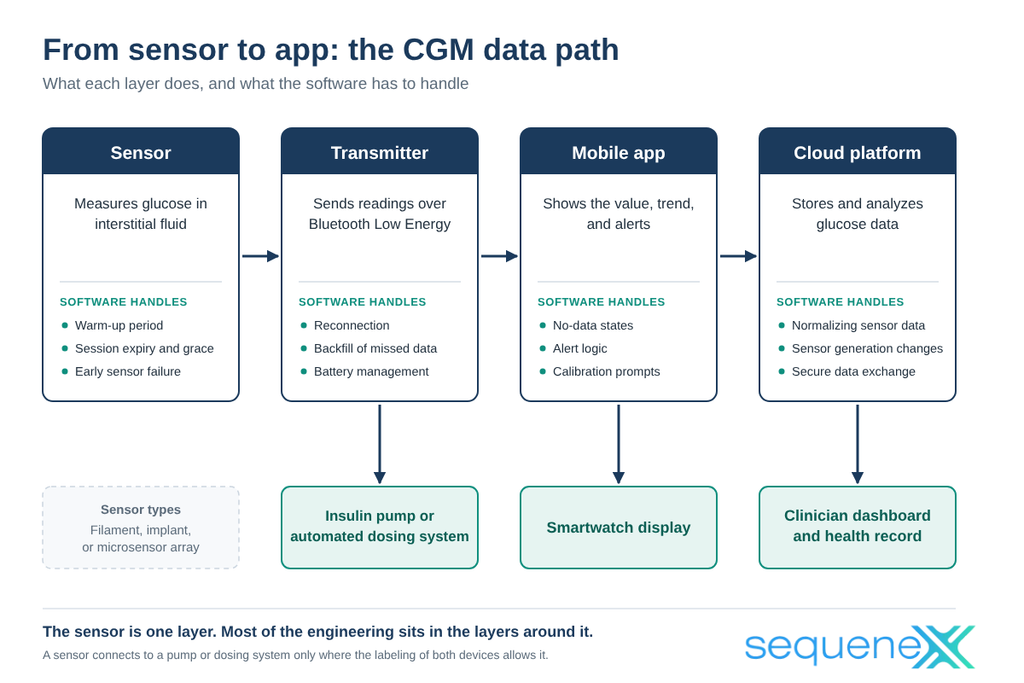
What watches and rings do today is display or interpret data from an authorized CGM.
- The Dexcom G7 connects directly to Apple Watch (Dexcom, June 2024).
- Compatible Garmin watches show Dexcom readings (Dexcom).
- Oura shows Stelo glucose data alongside meals, sleep, stress, and activity in its app (Oura and Dexcom, May 2025).
The FDA draws the same line. Its safety communication states that unauthorized glucose-sensing wearables are different from smartwatch applications that display data from FDA-authorized glucose devices.
Multi-sensor wearables remain unlaunched
The GlucoRx BioXensor, a radio frequency wearable that combines glucose estimation with other vital-sign sensors, has not reached the market. Its product site still lists the device as pending CE and FDA approval, and we found no published pivotal clinical results. Accuracy figures quoted in earlier press coverage could not be confirmed in a peer-reviewed paper.
The design idea behind it still matters for product teams. A wearable that carries several sensors can serve multiple clinical uses, and the software layer determines which use the product addresses. That holds for multi-sensor devices built on an authorized CGM as well.
What the clinical evidence shows
Published clinical studies of noninvasive CGM technology are small and preliminary. Their methods differ from one another and from the trials behind marketed sensors, so the results below are not a head-to-head comparison.
| Developer | Method | Study size | Reported MARD | Source |
|---|---|---|---|---|
| DiaMonTech | Mid-infrared photothermal | 35 participants analyzed | 19.6% to 20.7% | Communications Medicine, 2025 |
| Liom | Raman spectroscopy | 20 adults (5 in validation) | 14.5% in validation | J Diabetes Sci Technol, 2025 |
| RSP Systems | Raman spectroscopy | 50 people with type 2 diabetes | 12.8% | Scientific Reports, 2025 |
| MIT and Apollon | Band-pass Raman | 6 healthy adults | 11.34% | J Diabetes Sci Technol, 2026 |
None of these devices has FDA clearance, and most of the studies were funded or authored by the developer. Recent reviews point to the same physical obstacles: weak glucose signals in near-infrared and Raman measurements, radio frequency methods that “measure indirect indicators rather than glucose directly” (Sensors, 2025), and sensitivity to skin tone, temperature, motion, and sweat (Sensors, 2023).
What Comes Next in CGM Technology
CGM technology is advancing fastest by building on sensors that already work: smaller, longer-lasting versions, additional analytes, and shallower placement in the skin. Approaches that sample other body fluids remain further out.
Smaller sensors and longer wear
The next generation of CGMs is smaller and lasts longer.
- Dexcom announced the G8 in May 2026 with a form factor 50% smaller than the G7 and an expected launch in late 2027 or early 2028. It has not been cleared (Dexcom investor day).
- Senseonics is running a pivotal trial of Gemini, a self-powered, battery-enabled version of its implanted sensor, and is developing a follow-on called Freedom, with Bluetooth built into the sensor itself (Senseonics annual report).
- In Europe, FiberSense announced in June 2026 that it had obtained a CE mark for an optical CGM worn for up to 28 days (FiberSense).
Longer wear is not automatic. Dexcom notes that about 26% of G7 15 Day sensors may not last the full 15 days (Dexcom), so the software must handle early sensor end gracefully. The materials and manufacturing side of this trend is covered in biosensor miniaturization.
Multi-analyte sensors
Multi-analyte CGM sensors measure a second biomarker alongside glucose. The FDA authorized the Abbott Libre Duo 10 Day in August 2026 as the first wearable in the US to continuously monitor ketone levels using the same sensor that measures glucose (FDA). Abbott plans a US launch later in 2026 (Abbott).
Dexcom lists multi-analyte sensing in its pipeline but has no cleared multi-analyte product. For software teams, a second analyte means a second data stream with its own alert logic, display rules, and validation evidence.
Intradermal microsensors
Intradermal microsensors measure glucose in the upper layer of the skin without an introducer needle. They use the same glucose oxidase electrochemistry as filament sensors, in an array of microsensors that sit in the papillary dermis. The FDA granted De Novo classification to the Biolinq Shine on September 23, 2025 (FDA De Novo database) and cleared it for over-the-counter use on September 18, 2026 (FDA 510(k) database).
The Shine is not a conventional CGM. The FDA classifies it as a glucose range monitoring system: it shows a color for in-range, high, or low glucose instead of a number, and it is intended for adults 22 and older who are not on insulin (FDA decision summary). Other microneedle sensors, such as the one from Sava, are still investigational (Sava, February 2026).
Sweat, tears, and saliva
Sweat, tear, and saliva sensors would eliminate the need for skin penetration, but each faces a measurement problem that has kept them in the lab.
- Sweat: glucose in sweat is about 100 times lower than in blood, and its correlation with blood glucose is often unknown (Zafar et al., Sensors, 2022).
- Tears: tear glucose is far lower than blood glucose and lags behind it, and enzyme-based lens sensors degrade quickly (Elsherif et al., Frontiers in Medicine, 2022).
- Saliva: most studies find a positive correlation with blood glucose, but saliva composition varies, and there is no standard collection protocol (Biomedicines, 2025).
Enzyme-free electrochemical sensors built on nanomaterials are also under study. A 2025 review found that reliability, biocompatibility, and calibration-free operation remain unresolved (ChemistryOpen, 2025).
Engineering Challenges Beyond the CGM Sensor
CGM technology reaches patients as a connected system, not as a sensor alone. A commercial product combines the sensor with a companion app, cloud infrastructure, analytics, and often an insulin delivery device, and much of the engineering risk sits in those layers.
The sensor facts above translate directly into software requirements.
| Sensor characteristic | What the software has to handle |
|---|---|
| Warm-up from 30 minutes to 2 hours | A clear no-data state at session start, with alerts suppressed until readings are valid |
| Wear time and grace periods that differ by model | Session timers, expiry warnings, and early sensor failure |
| Different reporting intervals (FreeStyle Libre 3 measures every minute; the Stelo app updates every 15 minutes) | Data normalization so trends and statistics stay comparable across sensors |
| Calibration on some sensors only | Calibration prompts and entry flows where the labeling requires them |
| Bluetooth link between sensor and phone | Reconnection, backfill of missed readings, and battery management |
| Sensor generations retired on fixed dates | Tested migration paths and support for mixed fleets during a transition |
| Second analytes such as ketones | New data models, alert logic, and verification evidence |
Three areas need early design decisions.
- Connectivity. The app has to reconnect without user action and backfill any readings missed while the link was down. See Bluetooth Low Energy in wearables for the protocol trade-offs.
- Interoperability. A CGM that feeds an insulin pump, an electronic health record, or a third-party app needs stable, documented data exchange. See diabetes tech interoperability.
- Predictive features. Glucose forecasting and personalized alerts depend on model validation, performance monitoring, and controlled updates. See AI-enabled medical devices.
Sequenex develops companion apps and cloud software for CGM and biosensor products, engineered under the rigor of our ISO 13485-certified QMS and aligned with IEC 62304. If you are planning software for a glucose sensor, see our CGM software development services.
Frequently Asked Questions About CGM Technology
What technology do CGMs use?
Most CGMs use an enzymatic electrochemical sensor: a filament under the skin coated with glucose oxidase that produces an electrical current proportional to the glucose concentration in interstitial fluid. Dexcom, Abbott, and MiniMed sensors work this way. The Senseonics Eversense uses an implanted fluorescence sensor instead.
How long does a CGM sensor last?
A CGM sensor lasts from about one week to one year, depending on the type. Wearable electrochemical sensors are labeled for roughly one to two weeks: up to 7 days for Guardian 4, 10 days for the Dexcom G7, and 15 days for the Dexcom G7 15 Day and FreeStyle Libre 3 Plus. The implanted Eversense 365 sensor lasts up to one year.
Is there a noninvasive CGM?
No noninvasive CGM is authorized in the United States. The FDA has stated that it has not authorized, cleared, or approved any smartwatch or smart ring intended to measure blood glucose on its own. Optical and radio-frequency devices are in clinical trials, and the results published so far come from small, preliminary trials.
Can a smartwatch measure blood glucose?
A smartwatch cannot measure blood glucose on its own. Apple Watch and compatible Garmin watches can display readings from an authorized CGM such as the Dexcom G7, but the measurement comes from the CGM sensor, not from the watch.
What is the difference between a CGM and an iCGM?
An integrated continuous glucose monitoring system (iCGM) is a CGM that meets the FDA’s Class II special controls for accuracy and for secure, reliable data transmission to digitally connected devices. iCGM status does not by itself authorize use with every insulin pump or automated insulin dosing system. Each pairing depends on the labeling of both devices; for example, Stelo is an iCGM not intended for use with insulin delivery. The definition is in 21 CFR 862.1355. The Dexcom G6 was the first iCGM, authorized in 2018.
Which CGMs are available without a prescription?
Stelo by Dexcom and Lingo by Abbott are sold over the counter in the United States for people who do not use insulin. The FDA has also cleared Abbott’s Libre Rio for over-the-counter use, along with the Biolinq Shine, which displays glucose ranges by color rather than numeric readings. Stelo was the first over-the-counter CGM, cleared in March 2024.
What does MARD mean for a CGM?
MARD stands for mean absolute relative difference. It is the average percentage difference between CGM readings and reference glucose values, so a lower figure indicates closer agreement. MARD values from different studies are not directly comparable because study design and glucose ranges affect the result.
